
Use case · Credit and underwriting

Spend credit time on the decision.

Agent Serve reads the borrower file, drafts the memo in your house format, checks it against credit policy, and waits for the credit officer.

A credit and underwriting use case for Agent Serve, the AI workspace where teams build, deploy, and manage AI agents: a workflow reads the borrower folder in the Library, drafts the credit memo, checks it against the credit policy and waits for the credit officer, while a dashboard and Chat prepare the committee pack.

At a glance

For credit analysts and the committee they serve.

Who it is for

Credit analysts, relationship managers, credit officers and underwriters in commercial lending and insurance

The problem it removes

A memo starts as a folder of statements, an application and emails. The analyst retypes figures into a template, rereads the credit policy for the right limits, and rebuilds the same committee pack every week. Decisions wait on paperwork, not on judgement.
What your team still controls

People decide

  • The credit officer signs off every memo; Agent Serve never makes a credit decision
  • The house memo format and the credit policy the draft is checked against
  • Which borrower folders and tables each team can open
  • Who receives the committee pack, and whether they can export it
Day one

What you can run first

  • A workflow that drafts the memo from the borrower folder
  • Your credit policy and underwriting guidelines in a knowledge base
  • Chat that answers questions about a borrower folder, with sources
Later

What you add once it is trusted

  • A committee dashboard of exposure, watch-list moves and new limits
  • A scheduled PDF of the pack before every committee
  • An exposures table with rules that flag limit breaches

Before and after

Less retyping, more judgement.

Less retyping, more judgement.
WorkBeforeWith Agent Serve
The memoBeforeFigures retyped from statements into a Word template.With Agent ServeAgent Serve drafts the memo from the folder in your format.
Policy checksBeforeThe analyst rereads the credit policy for limits and conditions.With Agent ServeThe draft is checked against the policy before review.
Committee packBeforeRebuilt every week from exports and old slides.With Agent ServeA dashboard arrives as a PDF before each committee.
Questions about a borrowerBeforeSomeone searches the folder and emails back an answer.With Agent ServeChat answers from the folder and shows the source.

How it runs

From a borrower folder to a signed memo.

Agent Serve prepares the draft and checks it. The credit officer reads it and makes the decision.

  1. 1

    The folder is chosen

    The analyst starts the workflow on a borrower folder in the Library: statements, the application and the term sheet.

  2. 2

    The documents are read

    The File block reads each document, and an agent pulls out revenue, debt, covenants and the purpose of the loan.

  3. 3

    The memo is drafted

    The agent writes the memo in your house format, and Guardrails check its claims against the credit policy knowledge base.

  4. 4

    The officer signs off

    A Human step sends the draft to the credit officer, who edits it and records the decision. The memo is saved back to the folder.

In depth

What the credit team opens each day.

Agent Serve keeps the borrower file, the draft and the committee view in one workspace.

01 · Library

The borrower file and the memo together

Agent Serve keeps statements, the application and the memo draft in one Library folder, and Chat can save a committee pack there as a Word document.

  • Attach a whole folder to a Chat message
  • Chat saves .docx, .pdf and .pptx files
  • PDFs and Office files preview in place
02 · Sharing

Share with the committee only

Agent Serve shares a memo with an email or domain allowlist, a password or SSO, and the link can be turned off when the committee is done.

03 · Dashboards

A committee pack that arrives on time

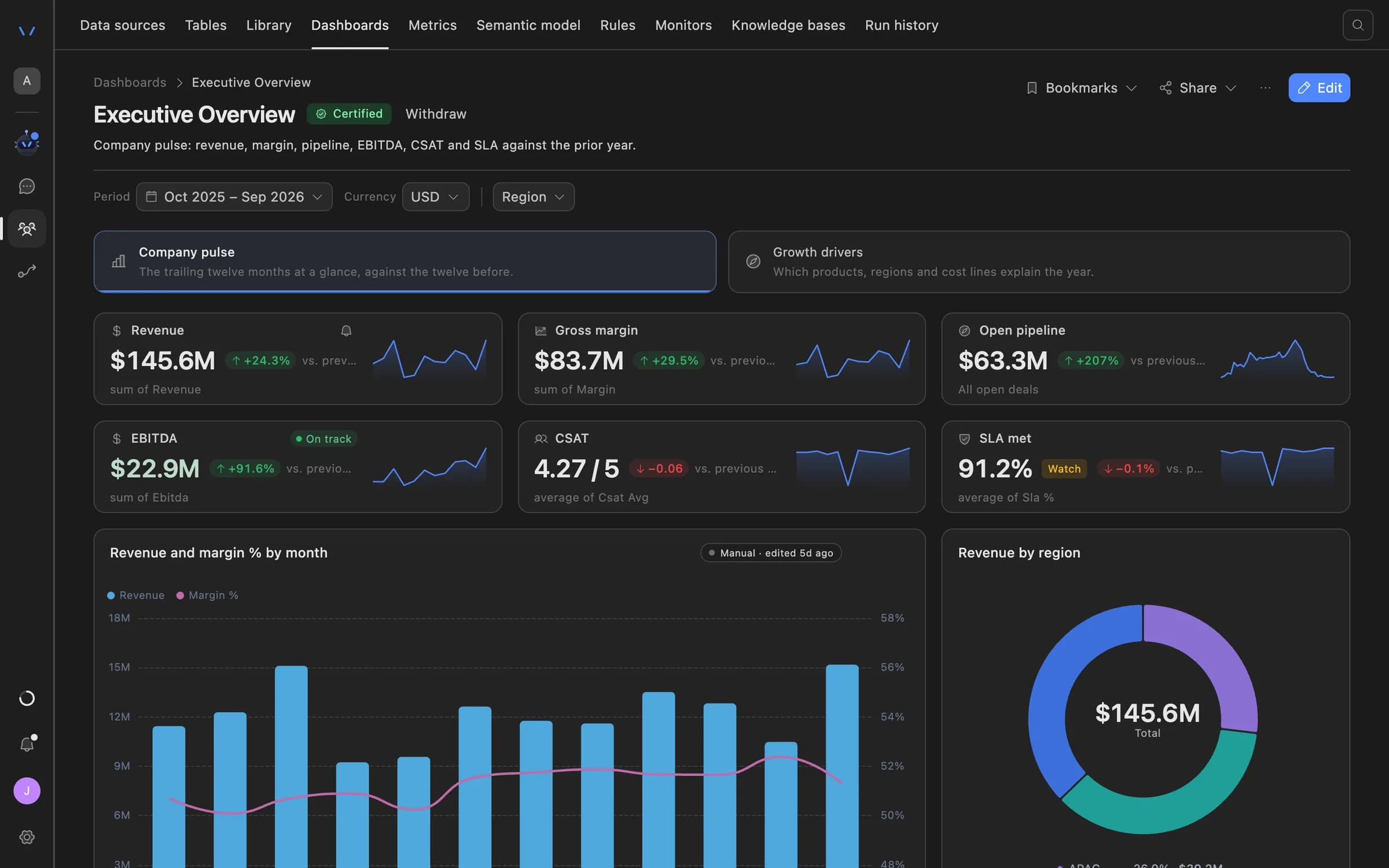
An Agent Serve dashboard shows exposure, watch-list movements and new limits, and Subscribe sends it as a PDF before every committee.

  • Up to 50 recipients
  • Drill into the rows behind a figure
Agent Serve dashboard showing an executive overview: revenue, gross margin, open pipeline, EBITDA, CSAT and SLA tiles with trend lines, a monthly revenue and margin chart, and revenue by region.
04 · Workbench

Try the terms before you propose them

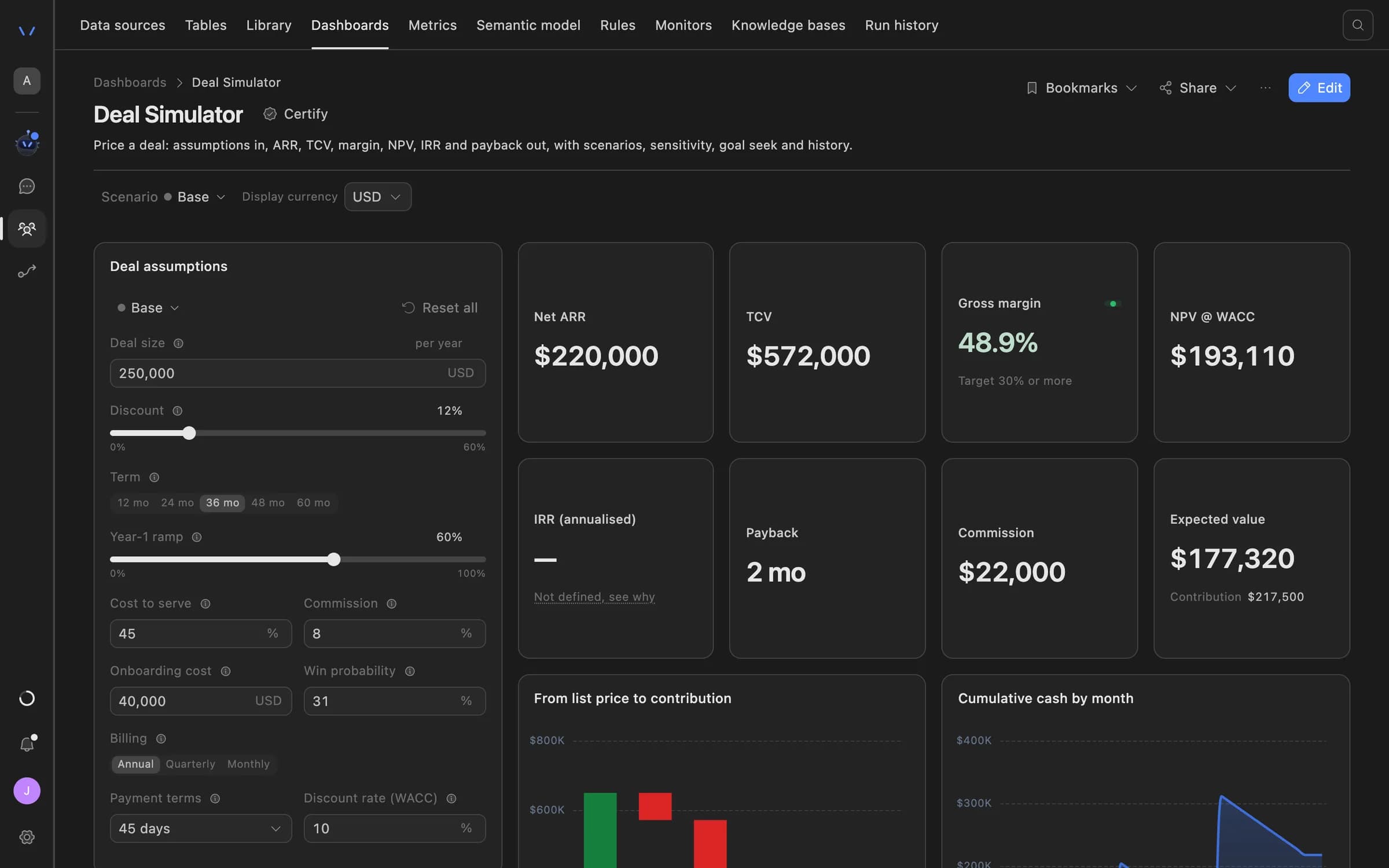
Agent Serve workbench scenarios recalculate outcomes as you change assumptions such as size and term, without touching recorded results.

Agent Serve Deal Simulator: deal assumptions such as size, discount, term and cost to serve on the left, with net ARR, TCV, gross margin, NPV, payback and commission recalculated on the right.

What does the work

The parts of Agent Serve behind each memo.

  1. 01Files

    Hold the borrower file

    The Library holds statements, applications and the memos written from them.

  2. 02Workflows

    Draft and check

    A workflow drafts the memo, checks it against policy and waits for sign-off.

  3. 03Knowledge bases

    Know the policy

    The credit policy and underwriting guidelines sit in a knowledge base.

  4. 04Chat

    Answer questions

    Analysts ask Chat about a borrower folder and keep the documents it writes.

  5. 05Dashboards & BI

    Prepare the committee

    A committee dashboard arrives as a PDF before each meeting.

Examples

Credit work in lending and insurance.

Three credit and underwriting jobs teams run on Agent Serve, each ending with a person’s decision.

Commercial lending

Credit memo drafts

An Agent Serve workflow drafts the memo from the borrower folder and the credit officer signs it off.

  1. Folder chosen
  2. Documents read
  3. Memo drafted
  4. Officer signs off
Banking · Credit risk

Weekly committee pack

An Agent Serve dashboard of exposure and watch-list moves is sent as a PDF before each committee, with notes saved to the Library.

  1. Data synced
  2. Dashboard updates
  3. PDF sent
  4. Committee meets
Insurance · Underwriting

Submission briefs

An underwriter attaches the submission folder in Agent Serve Chat and asks for a brief checked against the underwriting guidelines.

  1. Folder attached
  2. Guidelines searched
  3. Brief written
  4. Underwriter decides

Examples show what teams can build in Agent Serve. They describe patterns, not named customer deployments.

Governance

Decisions stay with credit officers.

Agent Serve drafts and checks. Credit officers decide, and every draft and decision is traced.

Security and governance
  • Folders by team

    Agent Serve applies team space roles to the Library, and access policies can turn off public file sharing for a group.

  • Claims checked against policy

    The Agent Serve Hallucination Check tests a draft against the credit policy knowledge base and flags what the policy does not support.

  • Approvals before action

    Relays never send email or book meetings without an approval, under any autonomy setting. An approval covers the exact payload the reviewer saw and expires if nobody decides.

  • Run logs

    Every workflow run records each block’s inputs, outputs and errors, so a reviewer can trace how a result was reached.

  • Audit trail

    Proposals, approvals, declines and executed actions are written to the workspace audit log, which admins can export.

  • Roles and permission groups

    Admin, write and read roles per workspace, plus permission groups that limit which models, blocks and integrations a team can use.

  • SSO and SCIM

    Sign in through your identity provider with SAML 2.0 or OIDC, and provision people with SCIM.

  • Self-hosting

    Run Agent Serve in your own cloud or data centre, next to the systems it reads.

  • Zero data retention

    Zero data retention with supported model providers, backed by your own provider keys and agreements or self-hosted models. Some provider features keep data by design, such as Gemini Deep Research, so they are outside zero data retention.

  • Bring your own keys

    Use your organisation’s own model provider keys at organisation or workspace level.

Further reading

Memos and committee packs, in depth.

The deep dive models the time a weekly committee pack takes and what changes, with every figure labelled.

Read the blog

Questions

About credit and underwriting

Does Agent Serve make credit decisions?

No. Agent Serve drafts memos and checks them against your policy. A credit officer reviews every memo at a Human step and makes the decision.

Can the memo follow our house format?

Yes. The Agent Serve workflow’s instructions and template set the structure, and Chat can save the result as a Word, PDF or Markdown file in the Library.

Can Agent Serve produce spreadsheets for the pack?

Not as .xlsx today. Agent Serve Chat saves Word, PDF, PowerPoint, Markdown, HTML and CSV files, and tables export as CSV.

Who can see borrower files?

Agent Serve applies the team space’s roles to the Library. Sharing outside the team uses an allowlist, a password or SSO, and admins choose which share modes are allowed.

What can we run first?

A team can start with the Agent Serve memo workflow and a credit policy knowledge base, then add the committee dashboard and its scheduled PDF.

Last updated

Enterprise access

Put AI agents to work across your team

Agent Serve is available to teams by invitation. Tell us what you want to build and we will set up your workspace with you.