
Agent Serve · Security

SOC 2 and GDPR ready. From day one.

Single sign-on, self-hosting in your own cloud and zero data retention with supported model providers, backed by the controls your auditors ask for.

Agent Serve, the AI workspace where teams build, deploy, and manage AI agents, is built for teams running SOC 2 and GDPR programs. It provides SAML and OIDC single sign-on with SCIM provisioning, self-hosting with a Helm chart or Docker, zero data retention with supported model providers, an exportable activity audit, access policies, row-level security, approvals, data retention settings, PII redaction, log destinations, encryption and invite-only access. Ready means the controls are in place; it is not a certification.
Out of the box

Three things security teams ask about first.

Single sign-on

Sign in through your identity provider

Agent Serve supports SAML and OIDC single sign-on, with SCIM 2.0 to provision people and groups automatically.

  • SAML 2.0 and OIDC, including Okta and Microsoft Entra
  • SCIM users and groups, mapped to access
  • Verified domains and invite-only sign-up
Self-hosting

Run it in your own cloud

Deploy Agent Serve inside your own cloud account or VPC, next to your data, with the same product your team sees here.

  • Helm chart for Kubernetes
  • Docker images with a production compose file
  • Reference Terraform for AWS, eu-central-1 by default
Zero data retention

Zero data retention with supported model providers

Run models under your organization’s zero data retention terms, or keep inference inside your network, and decide how long Agent Serve keeps logs.

  • Bring your own provider keys and agreements
  • Self-hosted models through Ollama, vLLM or LiteLLM
  • Configurable log retention and PII redaction

SOC 2 ready and GDPR ready mean the controls are in place. Agent Serve does not claim a SOC 2 report or a certification; certification is your organization’s or a future audit’s scope. Zero data retention is backed by your own provider keys and agreements, self-hosted models, configurable log retention and PII redaction. Some provider features keep data on the provider’s side by design — for example Gemini Deep Research requires stored interactions — so they’re outside zero data retention.

In depth

The settings behind each control.

Each Agent Serve control lives under Organization & governance in settings, where admins set it and auditors can see it.

01 · Identity

Sign in through your provider

Agent Serve supports SAML and OIDC single sign-on with verified domains, and SCIM 2.0 provisions people and groups from your identity provider.

  • Session policies: maximum lifetime and idle timeout
  • Sign out all members in one step
  • Admins can turn off personal API keys
02 · Access policies

Decide what each group can use

Agent Serve Access policies limit which blocks, models and integrations a permission group can use, on top of admin, write and read roles.

  • Roles per team space: admin, write, read
  • Row-level security on tables and dashboards
  • Column restrictions for sensitive fields
03 · Activity audit

Every change on the record

The Agent Serve Activity audit lists workspace and organization activity, including Relay approvals and declines, and exports it as CSV.

  • Search and filter by time range
  • Export to CSV for your evidence folder
  • Every workflow run keeps a block-by-block trace
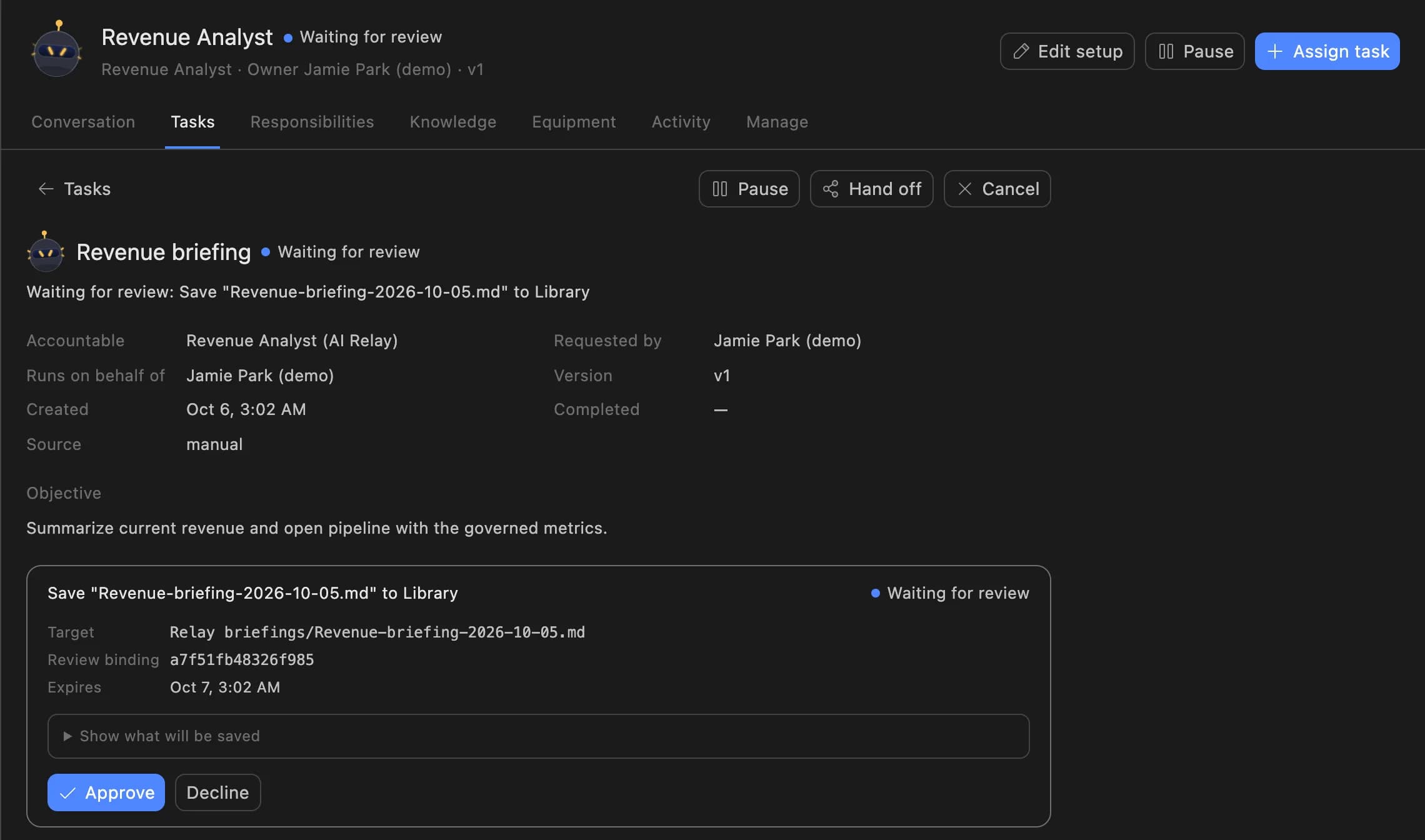
A Relay task in Agent Serve waiting for review: the Revenue Analyst asks to save a revenue briefing to the Library, with Approve and Decline buttons.
04 · Retention and PII

Keep less, redact the rest

Agent Serve keeps data from 1 day to 5 years, or forever, and redacts 40 types of personal data at the Logs, Workflow input and Block outputs stages.

  • Set retention per organization or team space
  • Choose the personal data types to detect
  • Add your own patterns
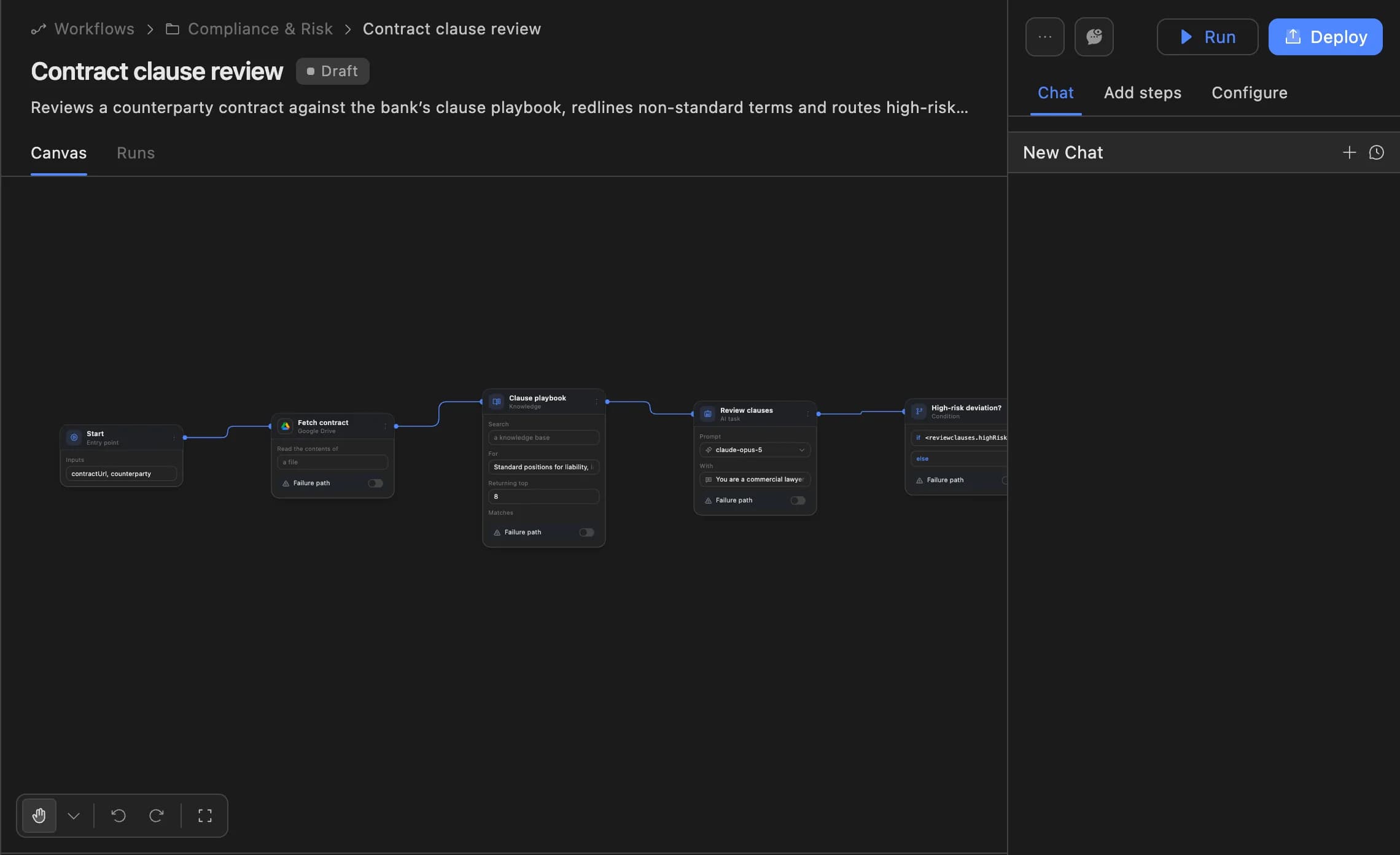
The Agent Serve workflow builder showing a contract clause review agent: start, fetch contract, clause playbook, review clauses and a high-risk deviation branch, with Run and Deploy buttons.
05 · Log destinations

Logs in your own systems

Agent Serve log destinations send workflow logs, job logs, audit logs and Chat history to your storage or monitoring tools every hour or every day.

  • Amazon S3, Google Cloud Storage, Azure Blob Storage
  • Datadog, Google BigQuery, Snowflake
  • Any HTTPS webhook

By the numbers

Controls you can count and check.

Log destinations

7

Log destinations

Personal data types detected

40

Personal data types detected

Stages where redaction applies

3

Stages where redaction applies

Roles per team space: admin, write, read

3

Roles per team space: admin, write, read

Counts are read from the product code.

Onboarding

From invitation to audited access.

How an organization brings people into Agent Serve, with identity, access and audit set before the first agent runs.

  1. 1

    Connect your identity provider

    Verify your domain and connect SAML or OIDC single sign-on.

  2. 2

    Provision people with SCIM

    SCIM 2.0 creates people and groups from your directory and removes leavers.

  3. 3

    Apply access policies

    Permission groups decide which blocks, models and integrations each group can use.

  4. 4

    Audit and export

    The Activity audit records each change, and log destinations stream records to your systems.

Supporting controls

Built for SOC 2 and GDPR programs.

Each control below is a setting or feature in Agent Serve today. Some are Enterprise features.

Approvals

Agent Serve Relays pause before external actions, and workflows can wait for a person at any step.

Send email → Needs approval

Export and deletion

Agent Serve exports logs, tables, knowledge, files, dashboards and workflows, and people can delete their own account.

Per-resource export

Encryption

Agent Serve encrypts secrets and credentials with AES-256-GCM. Reference cloud deployments encrypt storage at rest and use TLS in transit.

AES-256-GCM · TLS 1.2+

Invite-only access

Agent Serve accounts are created by invitation. Session lifetime and idle timeouts are set per organization.

Invite → SSO → Session policy

Regional hosting

The reference Agent Serve AWS deployment runs in eu-central-1 (Frankfurt) by default, or in the region you choose when you self-host.

eu-central-1

Your own model keys

Agent Serve uses your organization’s own model provider keys, set at organization or team space level.

Settings → Model API keys

Run traces

Every Agent Serve workflow run records each block’s inputs, outputs and errors.

Run → Block → Output

Guardrails

Agent Serve Guardrails check model output for valid structure, patterns, unsupported claims or personal data before it moves on.

Hallucination check

Self-hosting

Agent Serve ships a Helm chart, Docker images with a production compose file, and reference Terraform for AWS.

Helm · Docker · Terraform

Before and after

Evidence on hand, not assembled at audit time.

Evidence on hand, not assembled at audit time.
WorkBeforeWith Agent Serve
Who can sign inBeforeSeparate passwords, and accounts left behind when people leave.With Agent ServeAgent Serve single sign-on with SCIM, so leavers lose access with your directory.
What AI agents may doBeforeAn assistant acts with whatever access its key has.With Agent ServeAccess policies, row-level security and approvals before external actions.
Audit evidenceBeforeScreenshots collected by hand before each review.With Agent ServeAn Activity audit exported as CSV, or streamed to your storage on a schedule.
Personal data in logsBeforeKept forever, unredacted, in whatever the tool stores.With Agent ServeRedacted at three stages and kept only as long as your retention setting.

Under the hood

Agent Serve security, in detail.

Agent Serve security, in detail.
Single sign-onSAML 2.0 and OIDC with verified domains (Enterprise). SCIM 2.0 provisioning.
RolesAdmin, write and read per team space, plus permission groups.
Access policiesLimit the blocks, models and integrations each permission group can use.
SessionsMaximum session lifetime, idle timeout, and Sign out all members.
Activity auditOrganization and workspace activity, exported as CSV.
Data retention1 day to 5 years, or forever, per organization or team space (Enterprise).
PII redaction40 personal data types at the Logs, Workflow input and Block outputs stages, plus your own patterns.
Log destinationsAmazon S3, Google Cloud Storage, Azure Blob Storage, Datadog, Google BigQuery, Snowflake or an HTTPS webhook, every hour or every day.
API keysTeam space and personal keys. Admins can turn off personal API keys.

Works with

Controls that reach every module.

Further reading

Governed solutions built on Agent Serve.

Questions

Security questions

Is Agent Serve SOC 2 certified?

No. Agent Serve is SOC 2 ready: the controls auditors look for, such as SSO, audit logs, access control, retention and encryption, are in place. Agent Serve does not hold a SOC 2 report today.

Is Agent Serve GDPR compliant?

Agent Serve is GDPR ready. It gives teams the controls a GDPR program relies on, including regional hosting, retention settings, PII redaction, data export and account deletion. Compliance depends on how your organization uses it.

How long does Agent Serve keep our data?

As long as your Agent Serve data retention setting says: from 1 day to 5 years, or forever, set per organization or team space.

What does zero data retention mean here?

Agent Serve works with model providers that offer zero data retention. It is backed by your organization’s own provider keys and agreements, self-hosted models that keep prompts in your network, configurable log retention and PII redaction. Some provider features keep data on the provider’s side by design — for example Gemini Deep Research requires stored interactions — so they’re outside zero data retention.

Do you sell our data or train AI models on it?

No. Valnora & Elric does not sell personal data and does not use your data to train AI models. To keep prompts out of a model provider’s systems, use zero data retention with a supported provider, your own provider keys, or a self-hosted model.

Do you offer a Data Processing Agreement?

Yes. Valnora & Elric offers a Data Processing Agreement (DPA) for Agent Serve customers. Email systems@valnoraelric.com to request one.

Can we host Agent Serve ourselves?

Yes. Agent Serve ships a Helm chart for Kubernetes, Docker images with a production compose file, and reference Terraform for AWS, so it can run in your own cloud or VPC.

Last updated

Enterprise access

Put AI agents to work across your team

Agent Serve is available to teams by invitation. Tell us what you want to build and we will set up your workspace with you.